
Tactical Dog Accessories: Building the Full Loadout
Gear & Hound is reader-supported. As an Amazon Associate we earn from qualifying purchases. When you buy through links on this page, we may receive an affiliate commission at no additional cost to you. Our editorial picks are independent of commercial relationships.
Tactical dog accessories, as a category
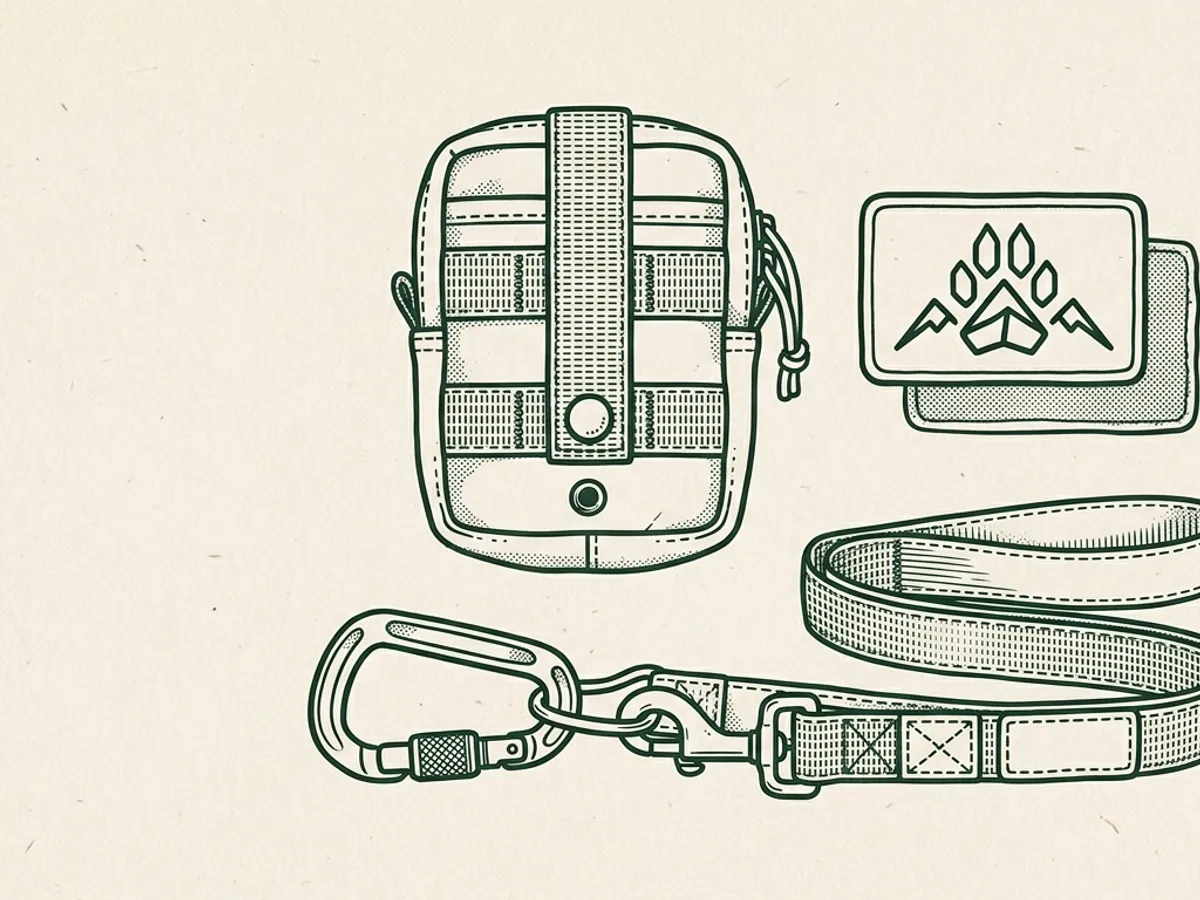
A tactical dog harness is the centerpiece of the category, but it’s never the whole kit. The handlers who actually use this gear — police K9, search-and-rescue, sport-dog, working-line handlers, and the growing population of large-breed owners who’ve migrated over because the hardware lasts — think in terms of a loadout. Collar, leash, harness, pouches, patches, sometimes boots. Each piece is built to the same standards, in the same materials, and meant to function as one system on the dog.
This guide covers the rest of the loadout. For harnesses specifically, our tactical dog harness deep-dive goes spec by spec on the chest-piece itself — MOLLE geometry, lift handles, hardware grades, sizing. If your priority is visibility instead of tactical aesthetic and load-bearing, our reflective dog accessories guide covers the parallel category for night walking and road safety. What’s below is everything that attaches to, hangs off, or extends a tactical harness — and how to assemble it without overspending on theater.
What “tactical” actually means in dog gear

The word does a lot of work in this category and not all of it is honest. Three distinctions are worth understanding before any of the picks below make sense.
Functional-tactical is gear built to military or law-enforcement K9 standards: 1000D Cordura nylon, mil-spec webbing, aluminum cobra or ITW Nexus side-release buckles, bar-tacked stress points, steel D-rings, and properly spaced PALS webbing where MOLLE is claimed. Brands at this tier — Ray Allen Manufacturing, 5.11 Tactical K9, some OneTigris SKUs — list the hardware in their specs because the hardware is the product.
Aesthetic-tactical borrows the visual language — coyote tan or ranger green, hook-and-loop patch panels, a top handle — without the underlying construction. Plastic D-rings, decorative loops that won’t seat a real pouch, 600D polyester instead of Cordura. These products aren’t bad; they’re costumes with utility, and they’re priced like costumes. The category problem is that listings rarely tell you which tier you’re in.
The cleanest tell is MOLLE/PALS geometry. True PALS webbing runs in 1-inch horizontal rows, spaced 1 inch apart vertically, stitched every 1.5 inches. If a brand says “MOLLE compatible” without that geometry, the panels are for displaying patches, not mounting load. That distinction decides whether a pouch stays put or works loose on the first hill.
Practical filter: if the listing names materials by spec (1000D Cordura, ITW buckles, 3/4-inch PALS), trust it. If it leans on adjectives (heavy-duty, military-grade, premium), treat it as aesthetic-tactical and price accordingly.
Building a tactical accessories kit
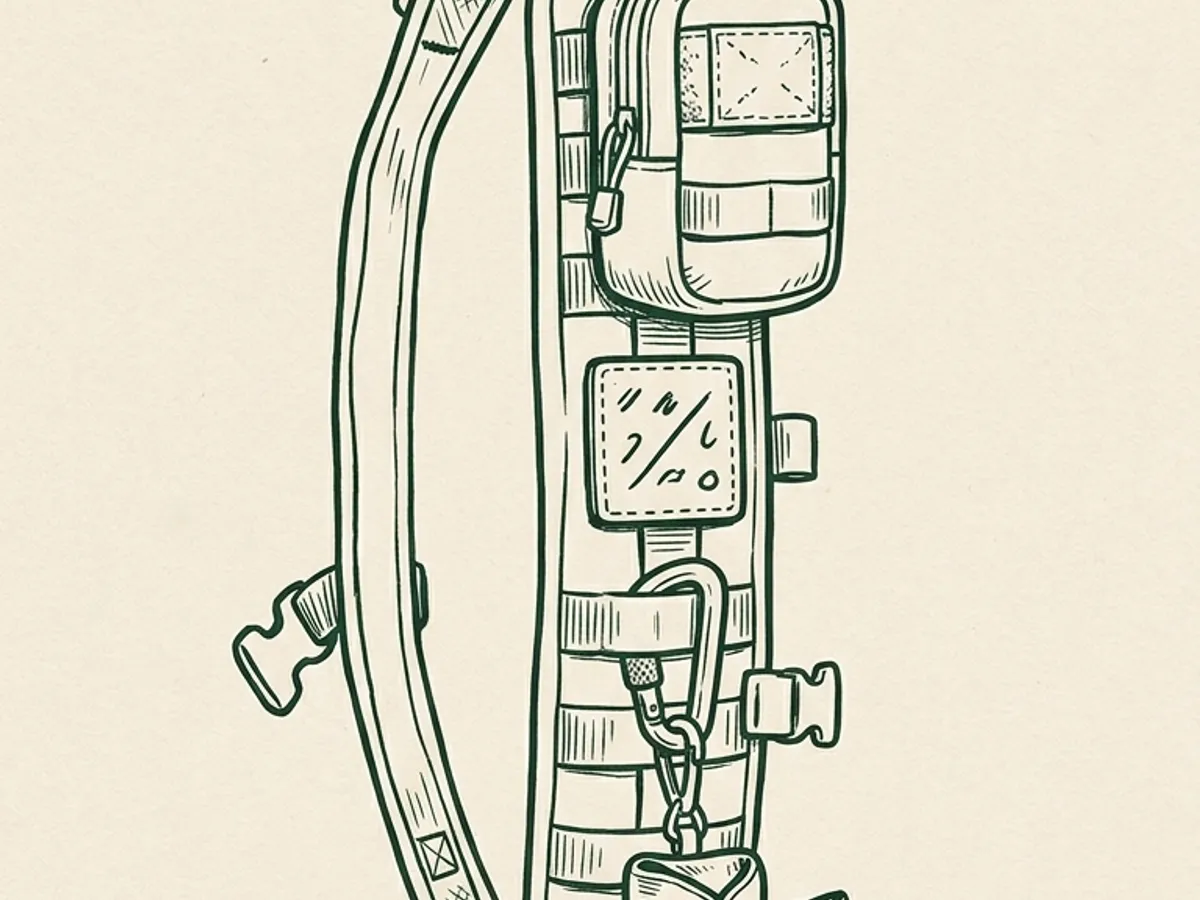
Think of the kit the way a handler builds a loadout: a structural platform plus modular attachments that solve specific problems. The harness from our deep-dive is the platform. Everything below either anchors to it or works alongside it.
Base layer — collar and leash. A tactical collar is the everyday wear; the harness comes off, the collar stays on for ID and quick control. The leash is the human-to-dog interface, where ergonomics matter most for the handler.
Modular layer — what mounts to the MOLLE platform on the harness: small pouches for treats, ID, poop bags, a basic first-aid kit. The platform exists to carry these; without them, the panels are decoration.
Identification layer — patches. Hook-and-loop patches communicate function (service dog, in training, do not pet, K9) faster than a verbal explanation in public. There’s an etiquette question for non-working dogs, which we’ll come back to.
Protective layer — situational: tactical boots for hot pavement or rough terrain, a collapsible bowl that clips to a belt loop or a MOLLE strap, a tag silencer so the dog’s ID doesn’t ring on a quiet trail.
You don’t need every layer. A weekend hiker with a 60-pound shepherd will stop at collar, leash, one pouch, and a bowl. A protection-sport handler builds out further. The right kit is the minimum number of pieces that solves the actual problems on your actual walks.
Our editorial picks across the category
The accessories below are sourced from each brand’s published product information and consistent owner-review feedback. We have not conducted hands-on field testing for this guide. Sizing should be confirmed against the brand’s chart for your specific dog.
Tactical collar: OneTigris Military Adjustable Dog Collar
OneTigris is the most consistent name in the consumer tactical accessory space, and the collar line carries the same construction language as the brand’s harnesses — 1000D-class nylon, a metal D-ring rather than plastic, a quick-release buckle, and a hook-and-loop patch strip across the front for ID patches. Sizing is published in inches of neck circumference rather than weight bands.
OneTigris tactical dog collar on Amazon.
What we like: the metal hardware at the leash attachment point, and the fact that the patch strip is sized to take standard 1x4-inch tactical patches without overhang. What to watch: the quick-release buckle is reinforced plastic, not metal cobra; on a strong puller, treat the leash attachment as the load-bearing point and the buckle as the closure.
Tactical bungee leash: Mighty Paw Bungee Tactical Leash
Bungee leashes absorb the shock of a sudden pull — for the dog’s neck or chest, and for the handler’s shoulder — by stretching across a built-in elastic section. Mighty Paw’s version pairs a bungee mid-section with a traffic handle near the clip, which is the second handle a handler grabs to keep a dog close in a crosswalk or a tight passage. The webbing is heavy-gauge with reflective stitching down the length.
Mighty Paw bungee tactical leash on Amazon.
The bungee’s stretch range is moderate — enough to take the snap out of a sudden lunge, not so long that the dog can build momentum into the slack. For a 50-90 pound dog that pulls intermittently, this is the rational default. For dogs that don’t pull, a non-bungee leash gives more direct feedback.
Tactical leash, no-stretch: WOLFpak Heavy Duty Tactical Leash
The other major form factor is a straight tactical leash — mil-spec webbing, a metal swivel clip, and usually a padded handle. WOLFpak’s version is built around 1000D nylon webbing with bar-tacked stress points and a 360-degree swivel snap that prevents the leash from kinking when the dog circles.
WOLFpak tactical dog leash on Amazon.
This is the leash for handlers who want direct contact — feedback travels up the line without the spring of a bungee. It’s also the leash to hand off to a dog walker or a trainer, because there’s nothing to explain. The traffic handle is shorter than Mighty Paw’s, which makes it more of a grab point than a sustained second grip.
MOLLE pouch: OneTigris Tactical Dog Saddle Bag / MOLLE Pouch
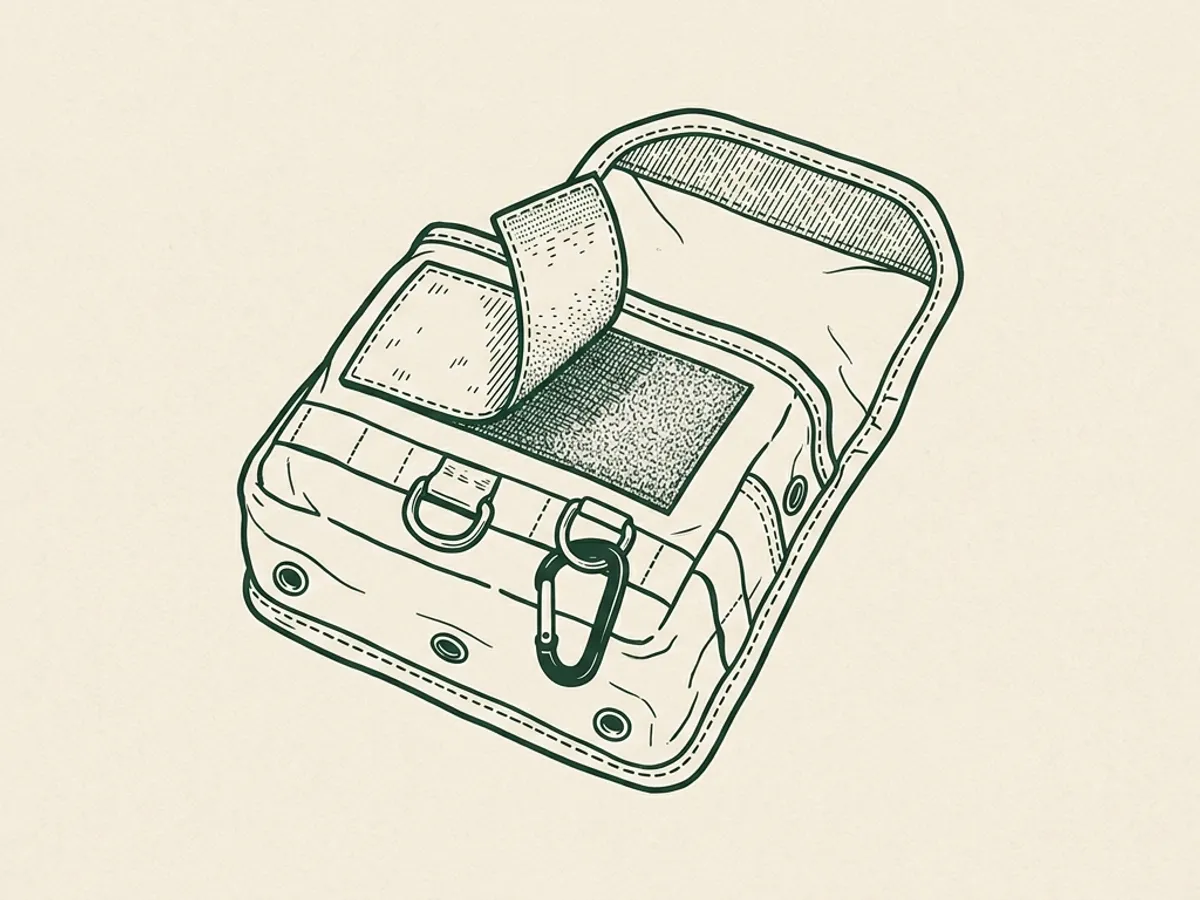
The whole point of the harness’s MOLLE platform is to mount these. OneTigris produces small pouches sized to clip onto a harness’s side panels, typically with two PALS-spacing straps and a hook-and-loop closure. Common contents: treats, poop bags, a folded leash backup, a small first-aid kit, an ID card in a sleeve.
OneTigris MOLLE dog pouch on Amazon.
Look for a pouch with two MOLLE straps rather than one — a single strap rotates and the pouch swings against the dog’s side. If your harness has properly spaced PALS (1-inch rows, 1-inch spacing), any standard MOLLE pouch will seat correctly. If your harness has loop-stitched panels rather than true PALS, expect the pouch to ride loose; either upgrade the harness or use the pouch on a belt instead.
Tactical patches: OneTigris and assorted
Hook-and-loop patches are the cheapest piece of the kit and the one that does the most identification work. Standard sizes — 1x4 inches for nameplates, 2x3 or 3x4 inches for shoulder patches — are interchangeable across brands. Common categories: “SERVICE DOG”, “IN TRAINING”, “DO NOT PET”, “K9”, American flag, blood type, and morale patches.
Tactical dog patches on Amazon.
A note we’ll return to in the FAQ: “service dog” patches are not regulated in the US — the ADA does not require credentialing — but using one on a non-service dog to gain entry to non-pet-friendly spaces is fraud in many states and a recurring source of complaints from working-dog handlers. Stick to honest descriptors.
Tactical dog boots: OneTigris Walker Series and competitors
Tactical boots solve specific problems: hot asphalt in summer, ice and salt in winter, gravel and lava-rock terrain, post-surgery paw protection. The tactical category prioritizes durable rubber soles, hook-and-loop closures over zippers, and reflective trim. OneTigris’s boots are the most common entry-point; Ruffwear’s Grip Trex sits at the premium end if you want a non-tactical-aesthetic boot at the same hardware tier.
Sizing is the issue. Measure the paw flat — toe to heel, widest point — under the dog’s standing weight, and match to the brand’s chart in millimeters or inches. Boots that fit too loose come off; boots that fit too tight chafe the dewclaw. Most handlers find a 50-percent failure rate on the first boot order and a 90-percent success rate on the second.
Collapsible bowl: OneTigris and others
A collapsible silicone bowl with a carabiner clip is the lowest-friction addition to any kit — it weighs nothing, clips to a belt loop or a MOLLE strap, and unfolds for water or food on trail. Tactical-aesthetic versions come in coyote tan or ranger green; the functional spec is identical to any silicone collapsible bowl. Collapsible tactical dog bowl on Amazon.
The honest take: this isn’t a place to spend more for “tactical.” Buy whatever matches your aesthetic at the lowest price — the silicone bowl is one of the most commoditized products in dog gear.
Tactical vs hiking accessories — when each matters
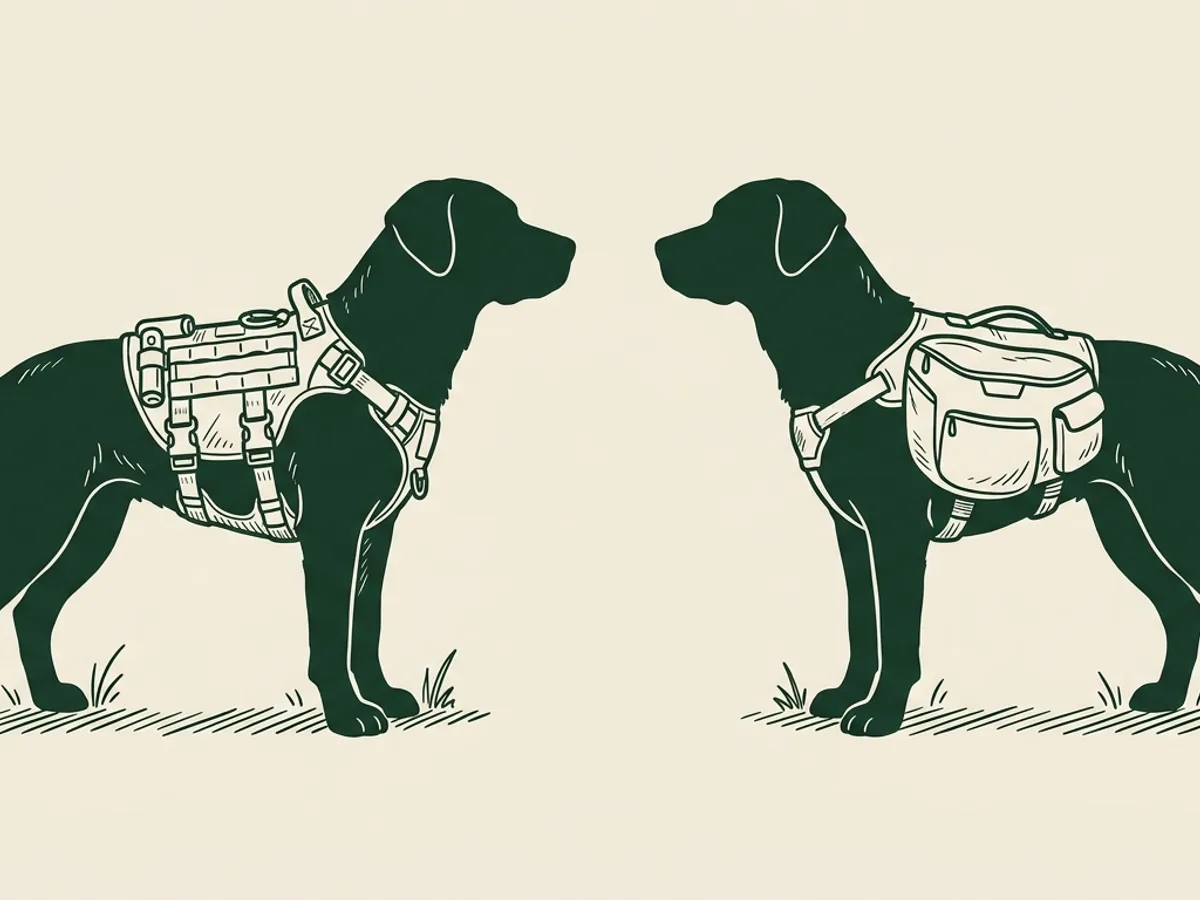
The categories overlap — both serve outdoor use, both prioritize durability — but the priorities split. Tactical optimizes for load-bearing, modularity, and handler control. Hiking optimizes for the dog’s all-day comfort and the owner’s pack weight.
A tactical harness can carry a pouch system; a hiking backpack like Ruffwear’s Approach Pack carries the dog’s own gear — water, food, jacket — over a long day. Different problems. If your priority is gear attachment and handler control on shorter outings, go tactical. If the dog is carrying multi-day supplies on trail, that’s hiking-pack territory.
The boot question is the cleanest split. Tactical boots prioritize aesthetic match and rubber-sole durability for mixed urban-to-rural use. Trail-specific boots like Ruffwear’s Grip Trex — covered in our hiking boots guide — have a sole profile tuned for rock and mud rather than pavement. Pick by the surface, not the look.
Buying notes and FAQ
Washing tactical webbing. Hand-wash with mild soap and air-dry. The dyes in coyote tan and ranger green are colorfast, but the webbing’s stiffness comes from a sizing that machine-washing breaks down. Rinse salt and grit out of buckles after coastal use.
When to size up the collar. If it sits flat against the coat with two fingers of clearance, it fits. Tactical collars are stiffer than fashion collars and break in over a few weeks; if it feels marginally tight on day one but the chart agrees with your measurement, give it the break-in period.
Patch etiquette for non-working dogs. “Do not pet” and “in training” are honest descriptors for any dog whose handler wants distance — reactive, recovery, or working-line dogs in conditioning. “Service dog” and “K9” patches communicate a working role; using them on a non-working dog to access non-pet-friendly spaces is fraud in most US states and the most common complaint from real service-dog handlers. The category is small enough that misuse damages the signal for everyone.
Hardware care. Inspect bar-tacking at leash clips, D-rings, and MOLLE attachment points every few months. Replace — don’t repair — when webbing frays near a load point.
Does it have to match? No. A coyote-tan collar and a black leash function identically to a matched kit. Do match the hardware tier across pieces — a 1000D Cordura harness paired with a 600D polyester leash is a weak link.
Editor’s pick
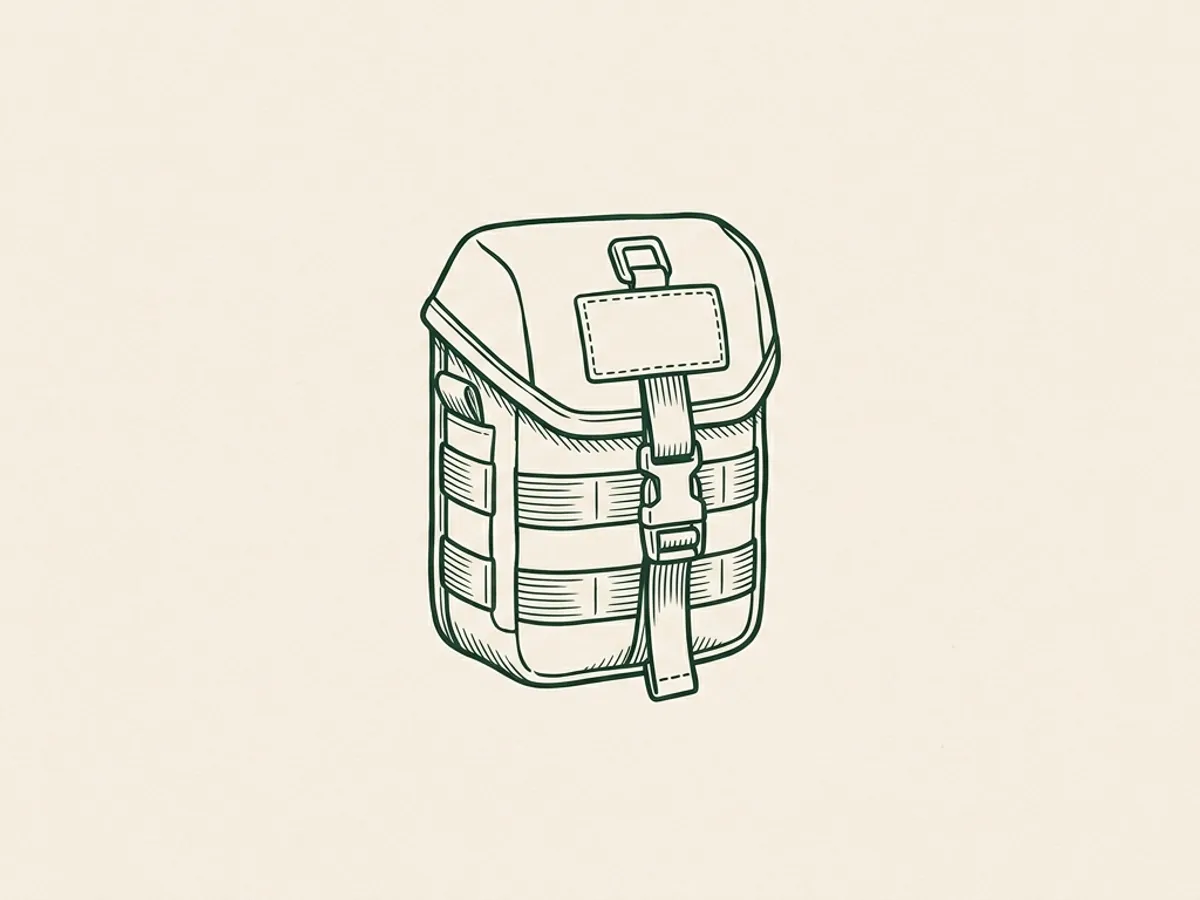
For most handlers building a tactical kit from scratch, the highest-leverage three pieces are a OneTigris tactical collar for everyday wear, a Mighty Paw bungee tactical leash for the walk-to-walk interface, and a pair of OneTigris MOLLE pouches to actually use the harness platform you’re already paying for. Add patches as needed for honest identification; add boots only if your dog walks on terrain that demands them.
For handlers who already own the tactical harness covered in our deep-dive, the accessories are how it earns the price. A harness with bare MOLLE panels is a costume; a harness with two pouches, a name patch, and a matched leash is a working loadout.
Pick by the problem you’re solving, not the aesthetic you’re matching to. The kit is doing its job when you stop noticing it on the walk.