
Tactical Dog Harness: Best Picks for Working & Large Dogs
Gear & Hound is reader-supported. As an Amazon Associate we earn from qualifying purchases. When you buy through links on this page, we may receive an affiliate commission at no additional cost to you. Our editorial picks are independent of commercial relationships.
A tactical dog harness is built to do three things a standard walking harness can’t: distribute load across a working dog’s chest and shoulders under sustained pull, give a handler a structural grip point for lifting or close control, and serve as a platform for attachable gear. The category borrowed its language — MOLLE, 1000D Cordura, cobra buckles — from military and law-enforcement K9 equipment, and most of the consumer options now sold on Amazon are simplified versions of the same pattern.
That borrowed pedigree is also why the category is noisy. Many listings claim “MOLLE compatible” when the panels are decorative loops too shallow to seat real pouches. Many claim a lift handle without quoting a tested weight rating. The honest version of this guide is short on hype and long on what the brand’s own product page actually says — and where it stays silent.
This page is for handlers of working breeds, sport-dog owners, hikers with large or pulling dogs, search-and-rescue volunteers, and anyone who wants a harness that survives more than a season of hard use. If you have a 12-pound dog who walks politely on a flat collar, you don’t need any of this. If you have an 80-pound shepherd who pulls into a stand and occasionally needs to be lifted over a creek crossing, read on.
What to look for in a tactical dog harness
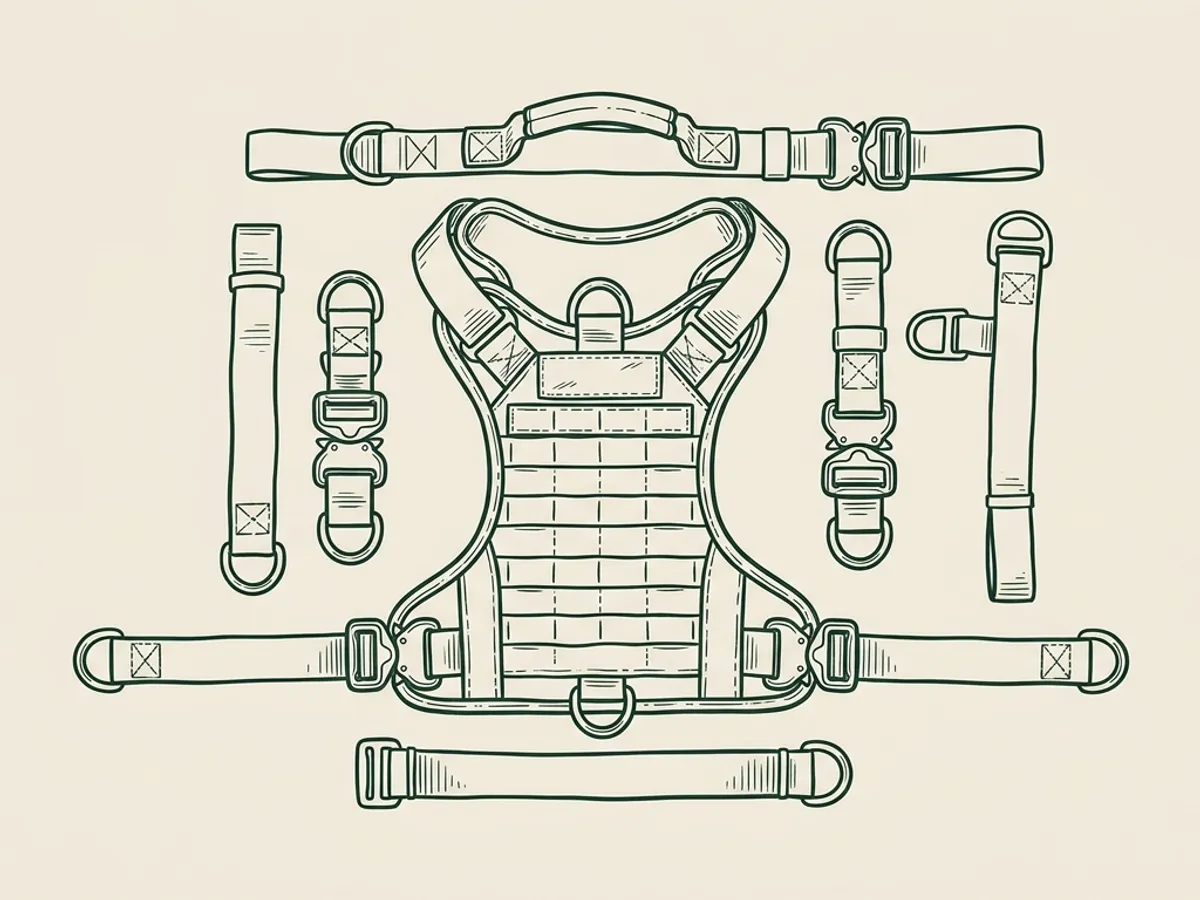
Chest girth range. This is the single most important spec, and the one most often glossed over. Every brand publishes a sizing chart with chest-circumference ranges in inches; measure the deepest part of your dog’s ribcage just behind the front legs, then match against the chart. Don’t trust “fits 40-80 lb dogs” — weight is a weak proxy for ribcage shape, especially across breeds.
Hardware grade. Quick-release side buckles in real tactical gear are aluminum cobra-style; consumer harnesses substitute reinforced plastic, which is lighter and cheaper but not load-rated. Steel D-rings on the back take a leash jerk better than cast aluminum; plastic D-rings should be a disqualifier on any harness over $40.
Lift handle vs. control handle. A lift handle sits centered over the dog’s shoulders, reinforced through the spine of the harness, and is meant to support the dog’s weight briefly — over an obstacle, into a vehicle, out of water. A control handle is shorter, sits forward, and is for keeping a reactive dog close at heel. Some harnesses have both. Manufacturers rarely publish a tested lift rating; when they do (Ray Allen, some 5.11 products), take it seriously.
MOLLE / PALS panels. Real PALS webbing has 1-inch horizontal rows spaced 1 inch apart, stitched every 1.5 inches. If a brand calls panels “MOLLE-compatible” without that geometry, treat the panels as patch-display loops, not load-bearing attachment points.
Material. 1000D Cordura nylon is the standard tactical webbing. 500D is lighter and wears faster. Neoprene padding under the chest plate is comfortable but holds water and odor; air-mesh dries faster. Leather (Ray Allen’s Schutzhund harnesses) is the durability champion but needs maintenance.
Drainage and ventilation. Working dogs sweat through their feet and pant for heat; the harness shouldn’t trap water on the chest. Look for grommets or open mesh under the chest plate.
Our editorial picks

Best overall: OneTigris MOLLE Tactical Dog Harness
OneTigris is the brand most consistently recommended in working-dog forums for handlers who want tactical functionality without a Ray Allen budget. The flagship MOLLE harness uses 1000D nylon with reinforced stitching at the load points, a top-mounted handle, both a steel front V-ring and back D-ring for leash attachment, and side panels with proper PALS spacing that will actually seat a small pouch. Sizing runs from medium (chest 21.7-27.6 in) through XL.
Check current pricing: OneTigris tactical dog harness on Amazon.
What we like in the spec: the front V-ring is steel, not stamped, and the handle is bar-tacked at four points rather than two. What OneTigris doesn’t publish: a tested lift rating. Treat the handle as a brief assist, not a rappel anchor.
Best for large and pulling dogs: ICEFANG Tactical Dog Harness
ICEFANG (sold under the Survival Gear BSO storefront) is the Amazon-dominant choice in the 60-100 lb range. The harness uses dual leash points, a metal V-ring up front for no-pull redirection, and a steel D-ring at the back for standard walking. The chest panel is broader than OneTigris’s, which spreads load across a larger surface area — useful for dogs that lunge.
ICEFANG tactical dog harness on Amazon.
Owner reviews consistently flag the buckle hardware as the failure point on dogs that genuinely fight the harness; if your dog is in the 90-lb-plus pulling category, inspect the side-release buckles every few months and budget for replacement. ICEFANG’s sizing chart goes to XL (chest 32.3-43.3 in).
Best budget pick: Auroth Tactical Dog Harness
Auroth has become the default sub-$35 entry in the category. The construction is honest about its tier — 900D-class nylon, plastic side-release buckles, lighter padding — but the geometry is correct: top handle, front and back leash points, MOLLE-style loops on the sides for patches. For a recreational hiker who wants the look and the basic control of a tactical harness without working-dog demands, this is the rational starting point.
Auroth tactical dog harness on Amazon.
What we’d flag: the buckles are not rated for sustained heavy pulling, and the side panels are loop-stitched rather than true PALS spacing. Buy it for a 25-50 lb dog and you’ll be satisfied; buy it for an unruly 80-lb dog and you’ll be back here in six months.
Best for the largest breeds: Rabbitgoo Tactical Dog Harness
Rabbitgoo’s tactical line extends into sizes that handle Great Danes, Saint Bernards, and giant working breeds where chest girth exceeds 40 inches. The brand publishes one of the more usable sizing charts in the category, with measurements taken at chest and neck rather than weight bands alone.
Rabbitgoo tactical dog harness on Amazon.
The construction is comparable to ICEFANG — 1000D-grade nylon, top handle, dual leash points — and the value proposition is mostly about availability in XL and XXL with proper chest-strap length. Reviewers note the chest pad runs slightly shorter than some giant-breed handlers would prefer; if your dog is deep-chested rather than broad, measure twice.
Best established brand: Kong Tactical Vest Harness
Kong’s entry into the tactical category brings the same brand QC that made the rubber chew toys ubiquitous. The vest is structurally closer to a working-dog vest than a pure tactical harness — broader coverage, more padding, less MOLLE platform — which suits handlers who want durability over modularity.
Kong tactical vest harness on Amazon.
The trade-off is configurability. If you want to mount pouches, patches, and accessories, OneTigris or ICEFANG give you more real estate. If you want a harness you can hand off to a dog walker without explaining it, Kong is the safer object.
Premium working-dog choice: 5.11 Tactical K9
5.11 makes tactical gear for humans first; the K9 line carries the same hardware standards. Expect cobra-style buckles, mil-spec webbing, and pricing that reflects the build. Availability shifts — 5.11 sells direct, through specialty dealers, and sometimes through Amazon third parties.
5.11 tactical K9 harness on Amazon.
This is the move for handlers who actually deploy the harness in a working context — sport, SAR, professional protection. For weekend hiking, you’re paying for capability you won’t use.
Tactical vs. hiking vs. training harness
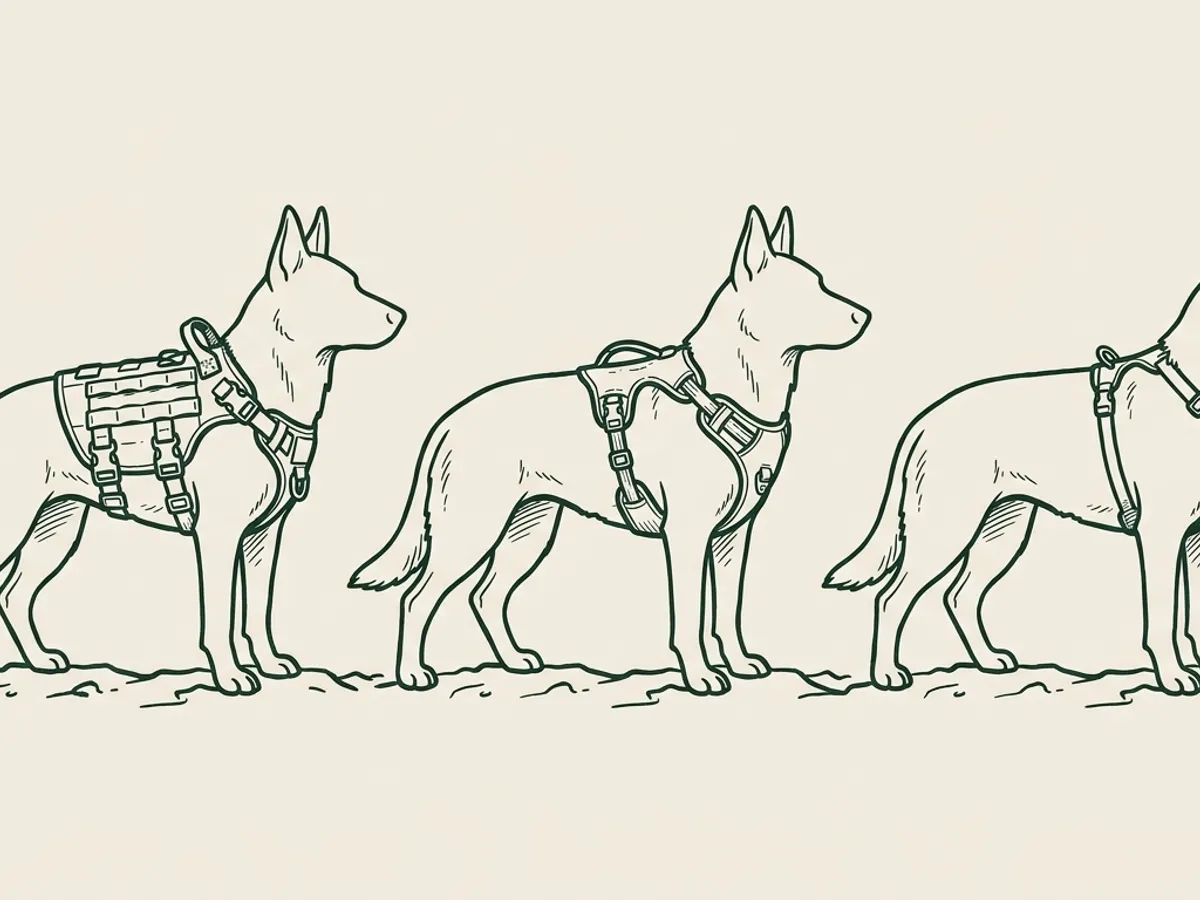
The categories overlap, but the design priorities split clearly:
Tactical harness — built for load-bearing, gear attachment, and handler control. Heavier, more hardware, more material. Best for working dogs, large pullers, and outdoor users who want a multi-purpose platform.
Hiking harness — built for long-day comfort and lift-assist. Lighter materials, padded chest plate, often a single top handle, minimal hardware. Brands like Ruffwear and Kurgo dominate here. Best for trail dogs in the 30-70 lb range without behavior issues.
Training harness — built around no-pull mechanics. Front-clip designs that redirect a pulling dog’s momentum. Lighter still, often without a handle. Best for in-progress leash training, not long wear.
A tactical harness can do hiking duty; a hiking harness can’t do tactical duty. If you only buy one and your dog is large, working, or strong, default tactical.
Buying notes and FAQ

How should it fit? Two fingers should slide between the chest strap and the dog’s body — flush but not compressive. The top of the harness sits behind the shoulder blades, not on them. The chest plate should clear the base of the throat by an inch.
When to size up. If your dog is between sizes, size up only if the harness has compression straps on both sides; otherwise the chest plate will gap. Puppies in a growth phase should be re-measured every 4-6 weeks until adult size is reached.
Hardware care. Rinse salt water and grit out of buckles after coastal or beach use. Inspect bar-tacking at the handle and D-rings every few months on a heavily used harness. Replace the harness — don’t repair it — when webbing shows fraying near load points.
Color choice. Coyote tan and ranger green dominate the category aesthetically, but if you walk a dog at dawn or dusk on trails shared with hunters, blaze orange or a high-vis variant is the safer call. Some brands offer reflective trim across the MOLLE panels.
Patches. Velcro patches are largely cosmetic, but a “DO NOT PET” or “WORKING DOG” patch on a tactical harness does communicate intent in public faster than a verbal request. Worth the $8.
Editor’s pick
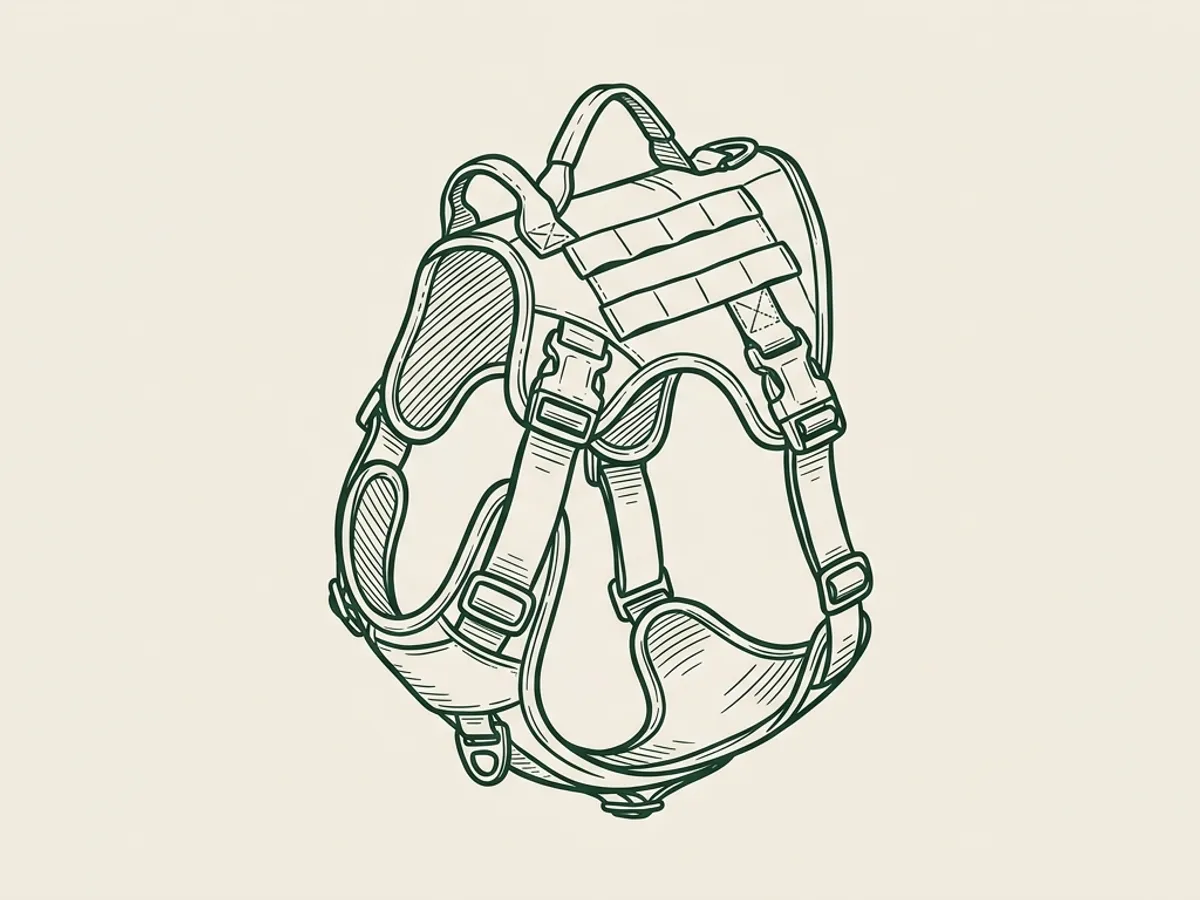
For most handlers reading this — large dog, mixed use, willing to spend mid-range — the OneTigris MOLLE Tactical Dog Harness is the recommendation. The hardware is honest, the geometry is correct, and the sizing range covers most working breeds. Step up to 5.11 if you have a deploying working-dog context; step down to Auroth if your needs are recreational and budget is the constraint; step sideways to Rabbitgoo if your dog is giant-breed.
Whichever you choose: measure the chest, read the brand’s sizing chart in inches rather than pounds, and treat the lift handle as an assist rather than a guarantee.