
Dog Hiking Backpack: Best Picks & Load Ratings Guide
Gear & Hound is reader-supported. As an Amazon Associate we earn from qualifying purchases. When you buy through links on this page, we may receive an affiliate commission at no additional cost to you. Our editorial picks are independent of commercial relationships.
A dog hiking backpack does two things at once: it gives a working-breed dog a job on a long trail — which most of them want, badly — and it offloads a few pounds of water, treats, and waste bags off your back and onto a body built to carry it. Done right, that’s a net gain for both of you. Done wrong, it’s a strap-rub injury and a pack you never use again.
The honest version of this category is short. Three or four brands dominate, the spec sheets are mostly comparable, and the differences that matter — load capacity, fit geometry, water resistance, hardware — are decided on the product page before any trail testing happens.
Dog packs are not appropriate for puppies under roughly 18 months, when growth plates are still closing; for dogs with known hip, elbow, or spinal issues; for short-nosed (brachycephalic) breeds on warm-weather hikes; or for any dog loaded near its body-weight ratio without conditioning. If any of that applies, leave the pack at home and carry the water yourself.
How a dog hiking backpack actually works
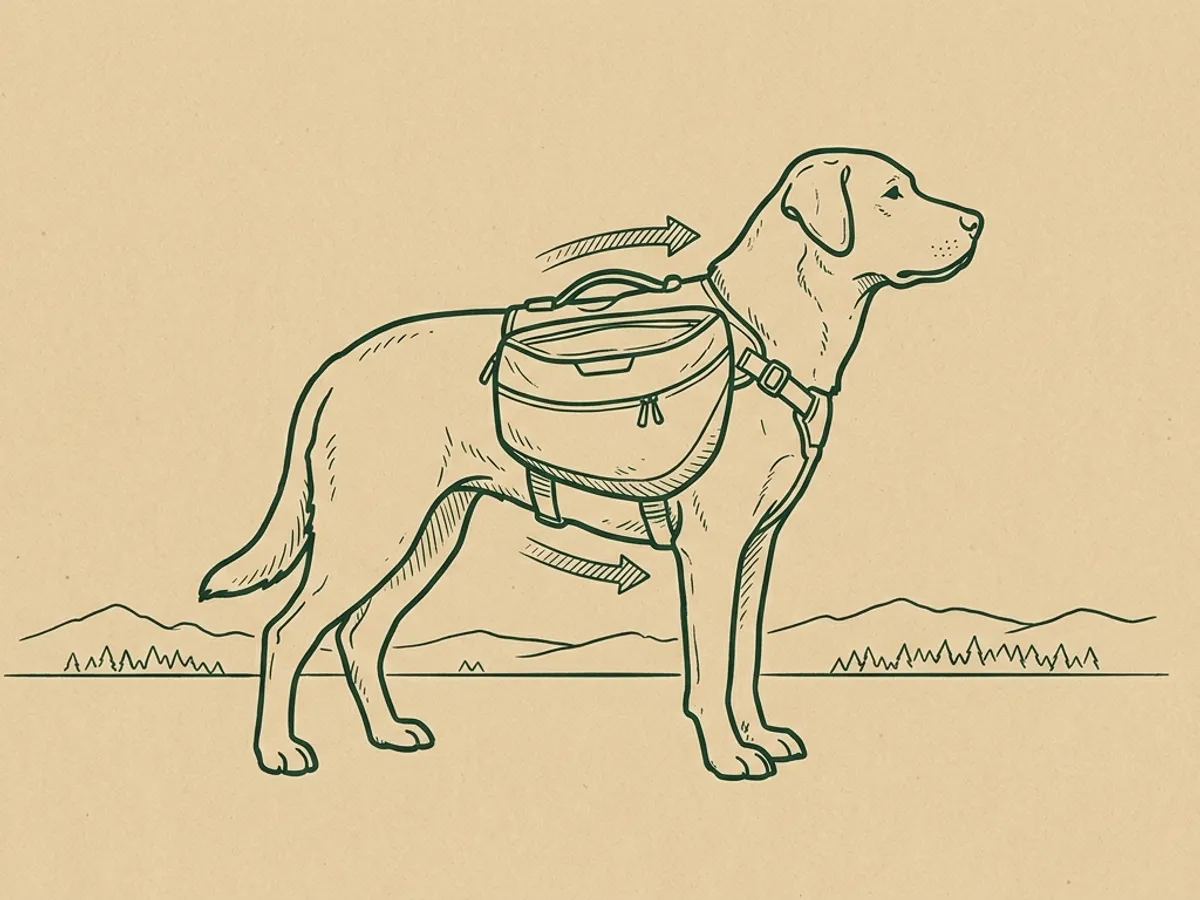
A dog hiking pack is structurally a harness with two saddlebags attached over the dog’s rib cage. The load sits high and forward — over the shoulders and front third of the rib cage, not on the lumbar spine or hips. A dog’s forelimbs carry roughly 60% of body weight at rest, and the musculature there is built to bear load. The lower back is not.
A correctly fitted pack distributes load symmetrically, with the saddlebags riding above the natural curve of the ribs and the chest strap sitting flush behind the front legs. The pack should not slide toward the hips during motion, rotate when the dog shakes, or press on the throat when the dog lowers its head.
Load is rated as a percentage of body weight. The conservative working range is 10-15% for a conditioned adult on moderate terrain; the upper bound cited by Ruffwear and most veterinary guidance is 25%. Brand-stated maximums vary by pack size, and should be treated as a ceiling, not a target.
What to look for
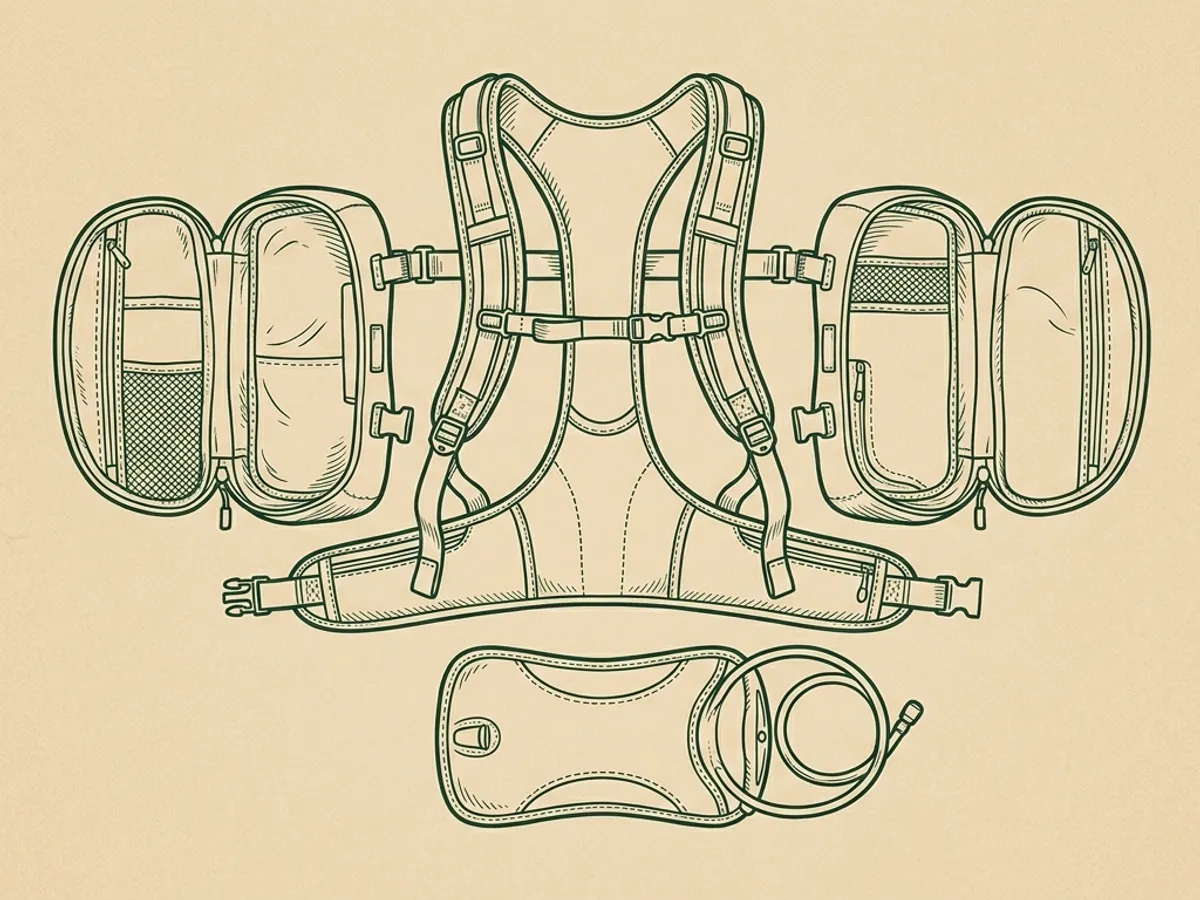
Load capacity (brand spec). Every reputable pack publishes a per-size load rating in pounds. Quote that number, not a percentage rule of thumb. Ruffwear’s Approach Pack lists capacities that scale with size; OneTigris and Mountainsmith publish their own. The rating is the pack’s structural ceiling — actual weight carried should be the lower of (a) that rating and (b) 10-25% of the dog’s conditioned body weight.
Fit and sizing. Sized by chest girth in inches, measured around the deepest part of the rib cage just behind the front legs. Weight ranges on size charts are approximations; girth is the real number. Size up only if the pack has compression straps on both sides.
Water resistance. Two terms get mixed up. “DWR-coated” (durable water-repellent) is a surface treatment that beads off drizzle — standard on most outdoor-brand packs, wets through in sustained rain. “Waterproof” implies sealed seams and immersion resistance, and is rare in this category. Pack contents inside a dry bag regardless of what the saddlebag claims.
Hardware. Aluminum buckles outlast plastic on heavy-use packs; steel D-rings outlast cast aluminum. Closed-cell foam padding sheds water; open-cell holds it.
Hydration compatibility. Some packs ship with collapsible water bladders built into the saddlebags (Ruffwear Singletrak); others have a sleeve for a generic bladder; most don’t.
Reflective trim and convertibility. Confirm reflective trim on the product page before relying on it. Some packs (Ruffwear Approach) have removable saddlebags so the harness functions as a standalone walking harness — useful for one piece of gear that handles trail and town.
Our editorial picks
Editorial incumbent: Ruffwear Approach Pack
Ruffwear is the brand most consistently recommended in long-distance hiking and thru-hiker dog communities, and the Approach Pack is its hiking-focused workhorse. The construction uses ripstop fabric across the saddlebags, a padded chest and belly panel, side-release buckles for fit adjustment, and a leash attachment on the harness itself. Saddlebags are removable, so the harness doubles as a daily walking harness.
Ruffwear Approach Pack on Amazon.
Verify on the brand’s product page before buying: the exact load capacity for your size (Ruffwear’s per-size ratings scale meaningfully — don’t average), and the current sizing chart in chest girth inches.
Lightweight with built-in hydration: Ruffwear Singletrak Pack
The Singletrak is Ruffwear’s lighter alternative for shorter days where the priority is the dog carrying its own water. It ships with two collapsible water reservoirs that sit in the saddlebags — the cleanest hydration integration in the category.
Ruffwear Singletrak Pack on Amazon.
Trade-off: less cargo volume than the Approach. Water plus snacks plus waste-bag dispenser, the Singletrak handles it; add a jacket layer or first-aid kit and the Approach has the room.
Competitive alternative: Mountainsmith K-9 Pack
Mountainsmith built its reputation on human hiking packs, and the K-9 carries the same construction sensibility — heavier-duty fabric than budget options, hardware sized for repeated use, and a fit profile that suits broader-chested dogs. Saddlebag volume runs generous for the size class.
Mountainsmith K-9 Pack on Amazon.
Confirm current sizing and load rating on the listing — not every retailer carries the updated spec sheet.
Tactical-aesthetic alternative: OneTigris Mammoth Dog Pack
OneTigris occupies the same niche in dog packs as in dog harnesses — tactical aesthetics, heavier fabric, MOLLE-style attachment loops, mid-range pricing. The Mammoth is the brand’s hiking entry, with saddlebags sized for multi-day use.
OneTigris Mammoth Dog Pack on Amazon.
Best fit: handlers who already own OneTigris gear, or anyone who values exterior gear-attachment loops. The fabric runs heavier than the Approach — durability for weight.
Popular mid-price option: Kurgo Baxter Backpack
Kurgo’s Baxter is the most visible sub-Ruffwear option in pet-store and Amazon listings, and it earns the placement: lighter than the OneTigris, simpler than the Ruffwear, with a chest-strap leash clip and saddlebags that handle a day-hike load.
Kurgo Baxter Backpack on Amazon.
It gives up the removable-saddlebag convertibility and some padding refinement. It gives back roughly half the price — the rational starting point for a hiker who isn’t yet sure how much their dog will actually use a pack.
Budget pick: Outward Hound DayPak
Outward Hound’s DayPak is the mass-market entry — widely available, sub-$30 typical pricing, sized for small and medium dogs. Construction is honest about its tier: lighter mesh, plastic hardware, modest padding. Best for short walks with a waste-bag dispenser and a treat pouch, not multi-hour hikes with meaningful load.
Outward Hound DayPak on Amazon.
Don’t load this near its stated max on rough terrain. The geometry is correct; the hardware isn’t built for sustained heavy use.
A category disambiguation: K9 Sport Sack
Worth a brief mention because the name keeps coming up: the K9 Sport Sack is not a pack for dogs to carry. It’s a forward-facing carrier — for you to carry the dog — for small breeds, injured dogs, or hikes that exceed what a small dog can walk. Different category. If you have a 10-pound dog and want longer hikes than its legs can handle, this is the relevant product. If you want your dog to carry water, it isn’t.
How much weight can a dog actually carry?
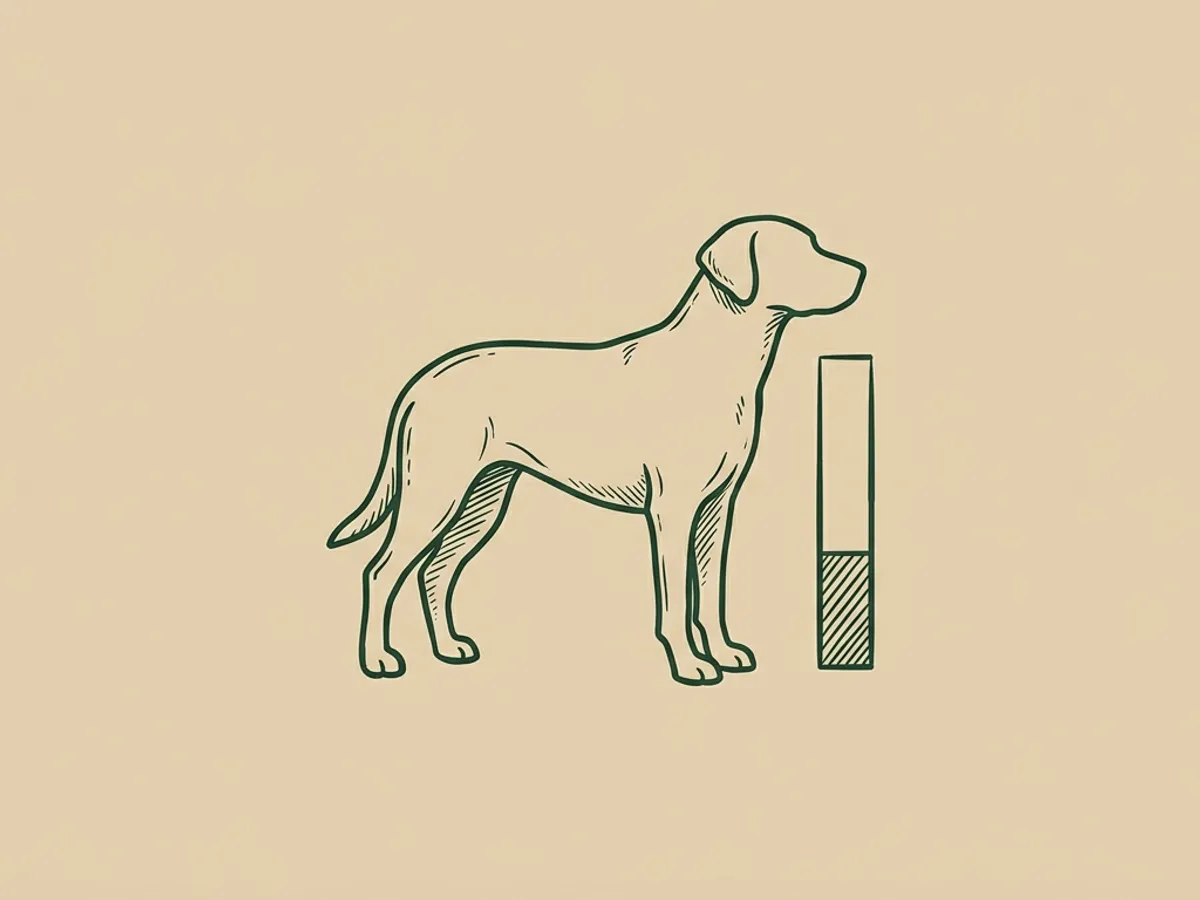
The widely cited rule is 10-25% of body weight, conditioned, on moderate terrain. The honest version has more variables.
Conditioning. Start with the empty pack alone for a week of normal walks, then add weight in increments — 5% of body weight, build to 10% over two or three weeks, then to working load. Loading an unconditioned dog at 20% on day one is how strap-rub injuries and sour associations happen.
Terrain and weather. Elevation gain, technical footing, heat, and trail length all reduce safe load. A dog that handles 20% on a flat 5-mile trail at 60 degrees is not the same dog at 20% on a 12-mile alpine route at 80.
Breed and age. Working breeds in their prime (2-7 years) carry the upper end of the ratio comfortably. Senior dogs, lean breeds without significant chest musculature, and dogs returning from injury sit at the lower end or skip the pack.
Brand maximums are ceilings. A published 10-20 lb capacity is the pack’s structural limit, not a recommendation. The lower of (brand max) and (body-weight percentage) wins.
Buying notes and FAQ
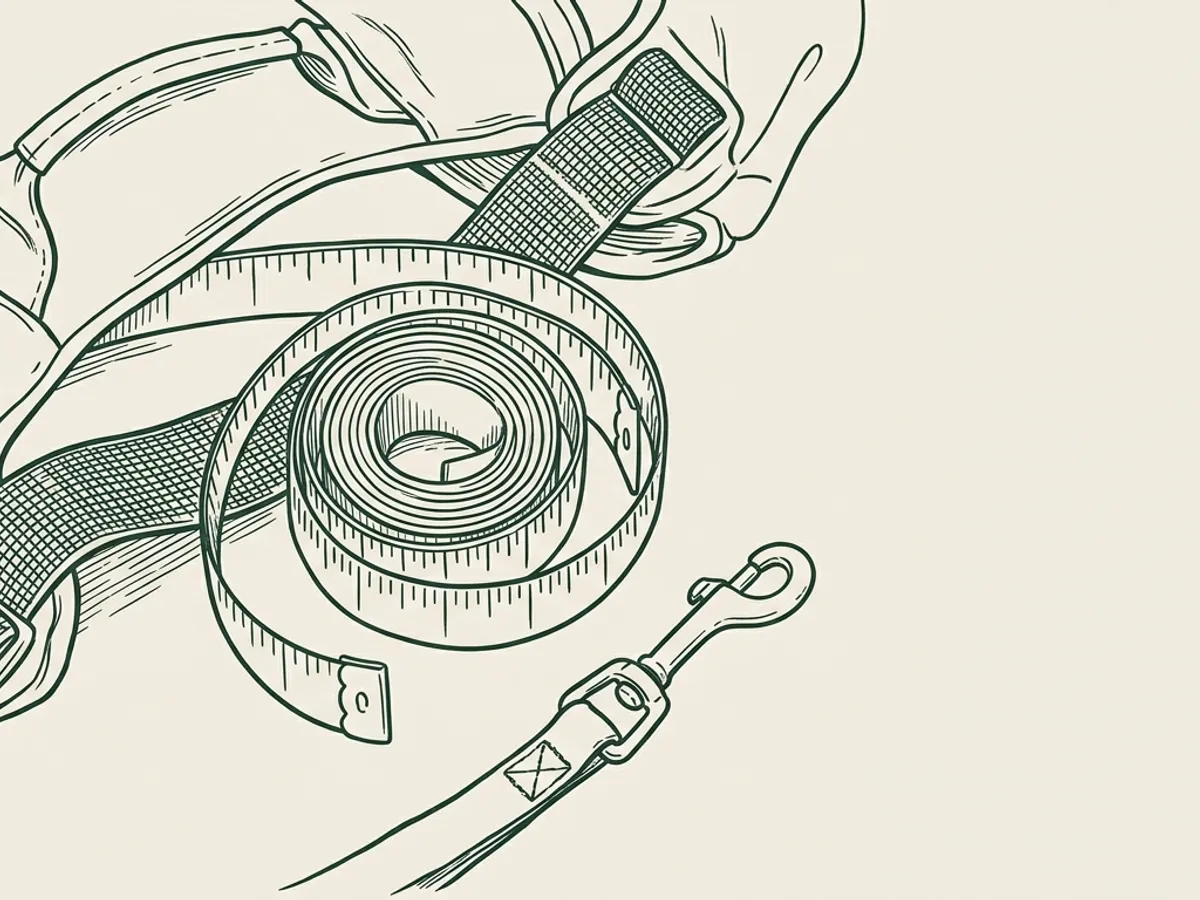
Fitting. Two fingers under the chest strap, flush but not compressive. The pack body sits behind the shoulder blades. Saddlebags balanced left and right within an ounce or two — uneven loading rotates the pack and causes rubbing.
Breaking it in. Empty pack first, then graduated weight. If the dog shows reluctance to walk, sits and refuses to move, or actively tries to remove the pack, reassess fit before assuming behavior.
When to leave it at home. Hot weather above the dog’s comfortable range, technical scrambles, water crossings deep enough to soak contents, and any hike where you’d describe the dog as “tired” before the pack is on.
Weather and care. DWR handles drizzle, not downpour — pack anything that can’t get wet into a dry bag. After wet hikes, empty the pack, rinse buckles, and air-dry inverted.
Twilight and low-light hikes. Reflective trim alone isn’t enough. Pair with a dedicated reflective or LED collar — see our reflective dog collar guide and LED dog collar guide.
Pack plus tactical harness. If you already run a tactical harness for daily walks, the tactical harness guide covers options with attachable pouches. For multi-hour hiking, a purpose-built pack distributes load more comfortably than a harness with bolted-on bags.
Editor’s pick
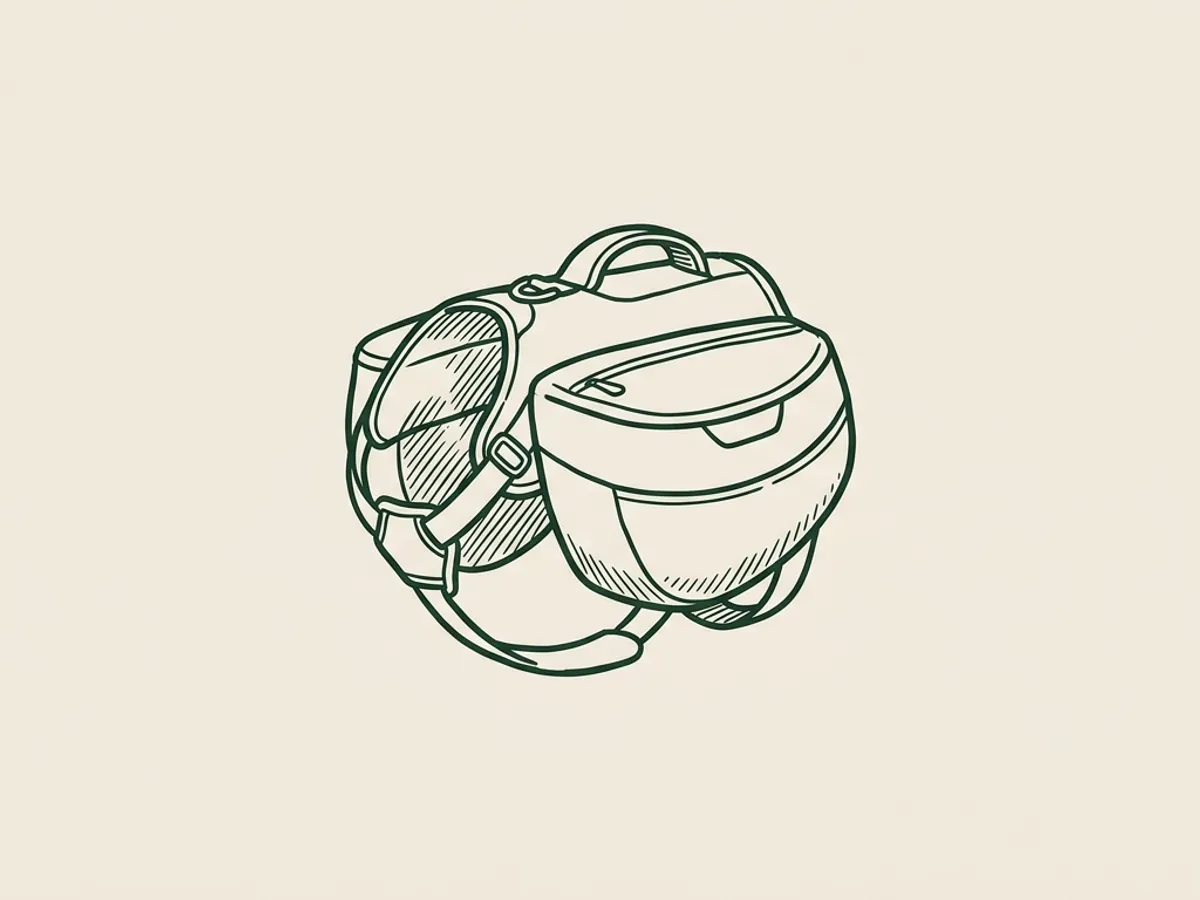
For most hikers reading this — medium-to-large dog, healthy adult, mixed day-hike use — the Ruffwear Approach Pack is the recommendation. The construction is the most refined in the category, the removable saddlebags double as a walking harness, and Ruffwear’s per-size load ratings are the clearest published data to plan against.
Step down to the Kurgo Baxter if budget is the constraint. Step sideways to the Ruffwear Singletrak if hydration is the priority over cargo. Step toward OneTigris Mammoth for tactical aesthetics and heavier fabric. Skip the category if your dog is a puppy, a senior, brachycephalic on warm days, or carrying anything you wouldn’t carry yourself.
Measure the chest in inches. Read the per-size load rating. Condition before loading. The pack is a tool; the dog is the athlete.